
What ephemerals can expect to see in our forests now?
Last week, bloodroot (Sanguinaria), took center stage, but another spring ephemeral flowers even earlier: Eastern skunk cabbage (Symplocarpus foetidus).
This fascinating plant often flowers in late February, the first of the spring ephemerals to bloom in Maryland’s Piedmont Region.
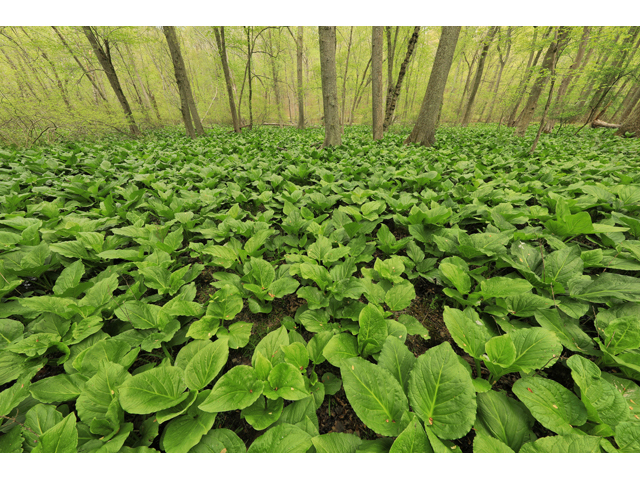
Though a native plant, skunk cabbage can still grow aggressively as this patch in Virginia demonstrates.
Found in wetlands and along streambanks, this native plant evolved during the Cretaceous period, 145 to 66 million years ago, when dinosaurs were at their peak.
It “…has remained essentially unchanged since that time, showing that its spectacular adaptations have made it an evolutionary success.
“It produces heat to attract the few pollinators emerging in winter’s frigid temperatures,” notes the National History Society of Maryland (NHSM).
The plant creates higher temperature inside the single bract that surrounds the flowering spike. These temperatures can be 15 to 35 degrees warmer than the surrounding air. The plants generate this heat by consuming carbohydrates stored in their fleshy rhizomes, states the National Park Service (NPS).
Skunk cabbage starts as a female flower and then changes into a male flower to promote cross-fertilization, the driving force in natural selection.
“Eastern skunk cabbage exploits a niche that no other plant does. It is an enigmatic guardian of swamp and wetland edges, some of our most critical habitats especially in the era of climate change,” notes the NHSM website.
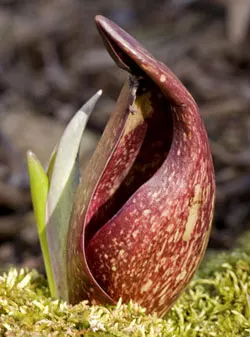
These plants do not produce seed until they are five- to seven-years old. Individual rhizomes, from which the leaves and flowers sprout, can persist for decades and maybe centuries, notes the NPS.
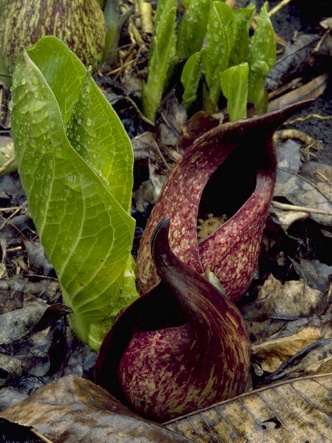
While you may not choose to plant Eastern skunk cabbage in your garden, it definitely should be admired for its extraordinary abilities.
Ephemerals: Trials and Tribulations
Spring ephemerals can be elusive in more ways than one.
The first Virginia bluebells (Mertensia virginica) I planted in the woods were repeatedly uprooted.
The next batch, I planted under my magnolia tree so I could keep an eye on them. Three years later, I am still waiting for them to emerge. There are some growing under the fringe tree. Did I forget and plant some there too?
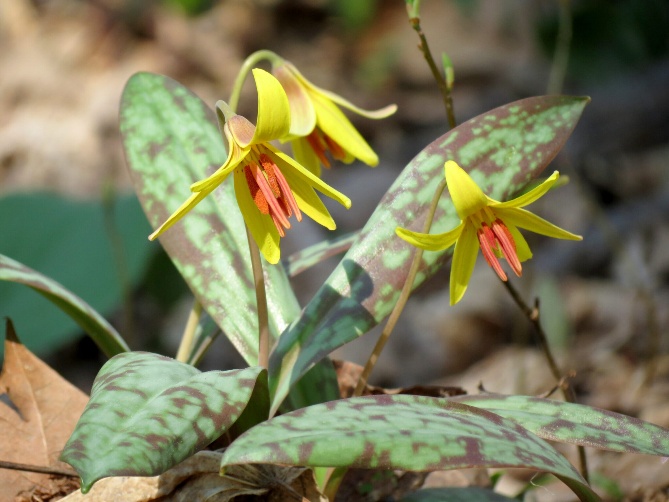
Yellow trout lily, Erythronium americanum, goes by many names including American trout lily, trout lily, yellow dogtooth violet, and yellow fawn lily. The center of the flowers’ center, where the petals meet, can be yellow, red, brownish, or orange-tinged.
Trout lilies (Erythronium americanum) appeal to me since they are native bulbs. The first year, nada. The following year, one lone stalk. Then I placed bulbs in a mesh container only to find it sticking out of the ground.
A lovely great white trillium (Trillium grandiflorum) had a good year only to be wiped out when the roof was redone. My beautiful shooting star (Primula meadia), a gift from my husband, had it blossom chewed off within 12 hours of being put in the garden. It spent the rest of the summer under a cloche. Only time will tell if it survived.
I refuse to be deterred! I hope to see my other trilliums, bloodroot, and spring beauties (Claytonia) soon and maybe even add a few more.
~Laura