
When my husband and I first saw our current home, I fell in love with the property as much or more than the house.
The sloping yard, characteristic of the Piedmont Region, included scores of magnificent blue spruces (Picea pungens) native to the central and southern Rocky Mountains.
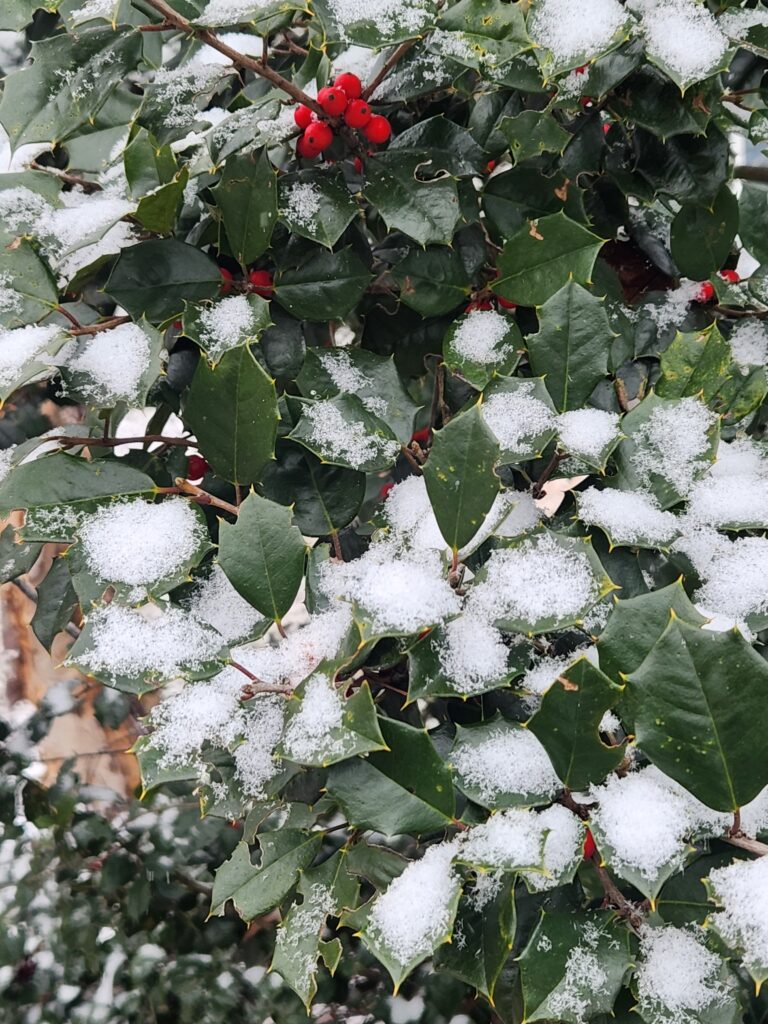
What I didn’t appreciate was the half-dozen native American hollies (Ilex opaca) scattered around the yard.
After several decades, the blue spruce are gone. They succumbed to age and disease. They are not suited to Maryland’s humid summers and often get fungal diseases like Cytospora canker and Rhizosphaeria needle cast, which causes browning needles and branch dieback.
It was heart-wrenching to have to cut them down.
But during the spruces’ decline, I began to appreciate the hollies. The original trees have grown to an impressive 50 plus ft.
We added a few more hollies to replace the blue spruce and to help create a screen between our neighbors’ yard and ours.
Over the years, numerous other hollies have appeared spontaneously throughout the yard. A male and female tree even grew up right next to each other. I only realized that they were two separate trees when I saw that only half the tree had berries.
American hollies provide birds with food, housing and shelter from predators. Every late winter, a huge flock of American robins fly into our trees to fill up on berries.
I have paused many a moment from my deskwork to watch innumerable birds, small and large, fly in and out of the hollies in the yard.
Laura M. O’Callaghan