
The American holly, Ilex opaca, stands out as one of the most versatile and elegant trees in any winter garden.
When most trees have lost their leaves, it offers a beautiful mix of green and vibrant red berries. It also serves as a screen and reduces the lash of winter winds.
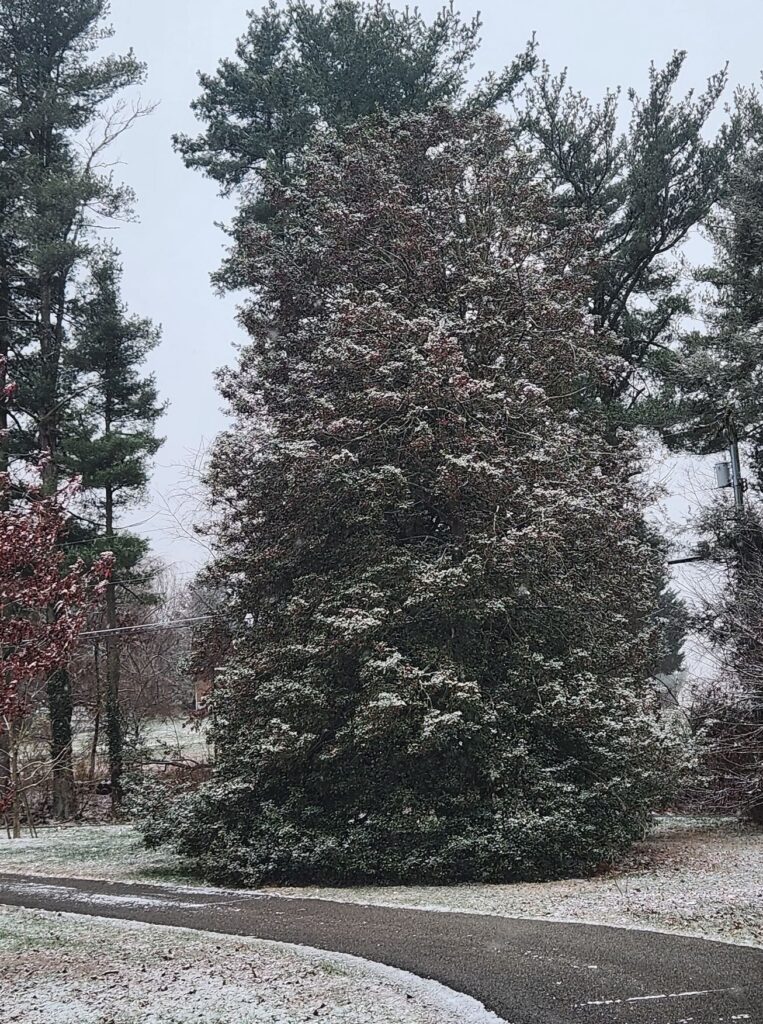
The hardiest of the broadleaf evergreens, the American holly grows relatively slowly. In full sun, they can reach 50 feet or more in Maryland’s Piedmont region.
Hollies are dioecious, some are female, others male. Both produce insignificant creamy white flowers between May to June; only the female produces red holly berries. The male and female need to be in proximity of one another for the female to bear berries. What is the magic distance?
“The male pollinator does not need to be right next to the female plant. Hollies are pollinated mainly by bees. Even 200 feet is within the range that bees can carry pollen. A large male holly tree can pollinate numerous female trees.
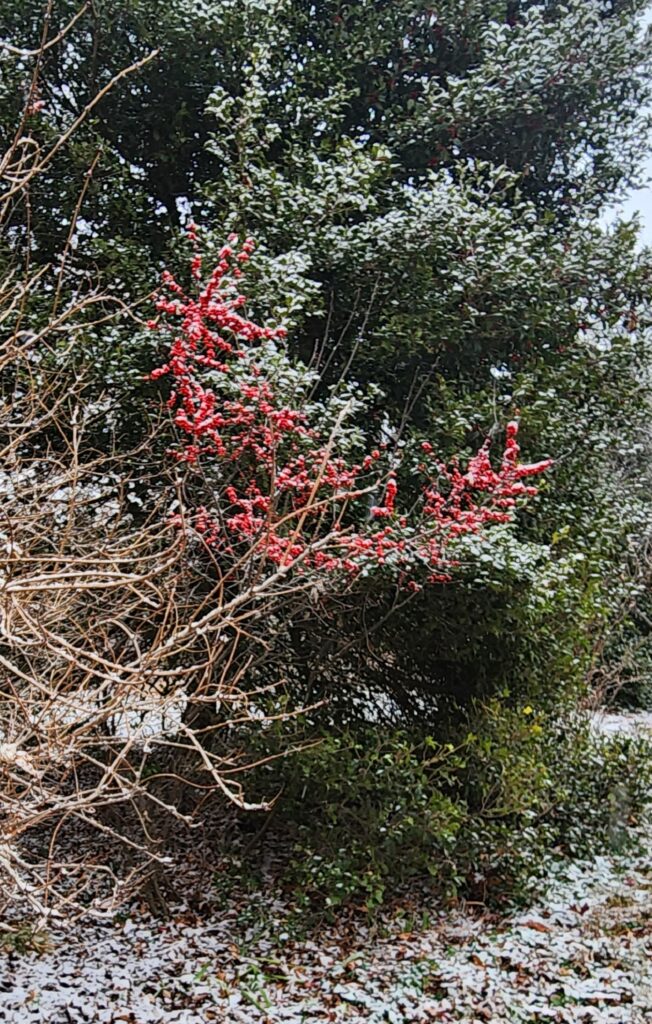
“Hollies are most efficiently pollinated by plants of the same species or variety. Thus, the ‘Jersey Knight’ cultivar of the American holly is able to pollinate many other female American hollies,” according to NYBG Plant Information Service.
The New York Botanical Garden also offer advice for gardeners whose trees aren’t blooming.
While bees primarily pollinate hollies, the tree attracts other pollinators including moths and flies. Holly trees serve as a host plant for Henry’s Elfin butterfly (Callophrys Henrici), caterpillars.
Range
The native range of American hollies runs from Massachusetts to Florida and west to Missouri and Texas, according to Michael A. Dirr, Department of Horticulture, University of Georgia and a preeminent authority on trees. He adds that they are frequently found in shady woods throughout the Southeast.
Other researchers note that the American holly is not typically found in Maryland’s Piedmont Region. Its range has been expanding due to birds spreading its seeds. They grow in zones 5 to 9.
Wildlife
Holly berries provide wildlife, especially migratory birds, with a valuable source of food.
In late winter and early spring, they compose a crucial part of American robins’ diet. The berries, which become sweeter after freezing and thawing, attract large flocks of robins who can strip a tree of its berries when they first arrive north. The berries provide robins with a high-energy source of food prior to nesting.
Other birds and mammals enjoy the berries as well. The nectar from its flowers creates excellent honey. Deer typically avoid its prickly leaves unless it is a hard winter.
Growing conditions
These beautiful evergreens grow best in full sun to part shade. They require little maintenance but do need a medium amount of water.
They tolerate deer, clay soil and urban conditions, according to the Missouri Botanical Gardens.
The Oldest Hollies in Maryland
A 300-year old American holly is among the oldest hollies in Maryland, according to John Hooven, Cape Atlantic (NJ) Conservation District Forester. The tree grows at the Wye Island Natural Resource Management Area.
~Laura